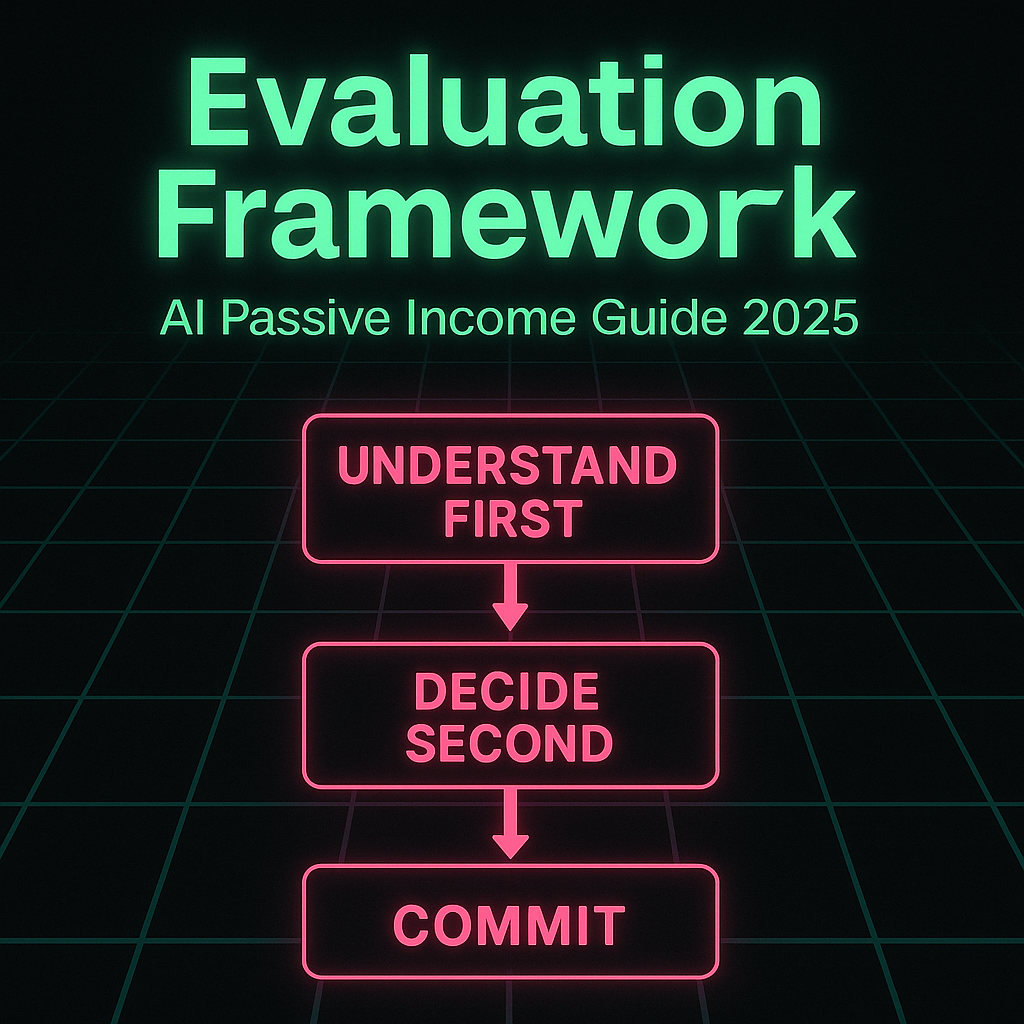
How to Evaluate AI Passive Income Platforms — A Practical 2025 Framework
AI-driven passive income platforms have become one of the most discussed digital trends of 2025. Yet despite their visibility, most people still evaluate them using outdated assumptions: emotional reactions, dashboard impressions, or unrealistic expectations about what automation can or cannot deliver.
This guide presents a practical, experience-based framework for evaluating these systems responsibly. Rather than viewing them as traditional investments, the goal is to treat them as structured experiments — systems that can be observed, tested, and understood over time.
1. Start With the Mechanism, Not the Number
Most users begin by asking: “How much does it pay per day?”
That’s the wrong starting point.
Daily output is just the surface layer. The deeper question — and the one that experienced evaluators focus on — is:
How does the system generate its daily behaviour?
To answer that, you need to understand whether the platform uses:
- fixed-pattern distribution
- adaptive algorithms
- tiered progression cycles
- rule-based yield mechanics
If you need a refresher on how programmed cycles actually work, the article Algorithmic Yield Explained walks through the fundamentals in a clear, non-technical way.
The mechanism always matters more than the number displayed on a dashboard.
2. Begin With the Smallest Possible Test
One of the biggest mistakes people make is scaling too fast. Early enthusiasm leads to overexposure, and overexposure distorts your perception of the platform’s behaviour. Even stable systems feel unstable when your exposure level is too high.
Your initial goal is not to maximize output — it is to gather information.
A proper test involves:
- a small deposit
- daily tracking for consistency
- immediate withdrawal testing
- monitoring internal patterns
This process protects you from emotional decisions and gives you the clearest possible read on the platform’s internal logic.
3. Track Daily Output — Patterns Reveal the Truth
Daily tracking is the most powerful evaluation tool available. A single day tells you nothing; a sequence of days shows the system’s underlying rhythm.
When tracking output, pay attention to:
- short-term variation — normal fluctuations include minor rises or dips
- long-term stabilization — does the system settle into a recognizable pattern?
- unexpected anomalies — do anomalies correct themselves?
- progression curves — some platforms adjust output over time based on programmed cycles
If you are unfamiliar with tracking methodology, see the overview on Daily ROI Platforms, which explains why output behaviour must be observed as a pattern rather than a promise.
A full guide on building your own tracking sheet will also be available soon under the new article: How Daily Tracking Works (With Real Examples).
4. Withdraw Early — It’s the Most Important Stress Test
Nothing reveals the health of a passive platform faster than withdrawal behaviour. Even platforms that appear stable sometimes struggle to process withdrawals efficiently, and these issues often appear before any other visible problems.
If you want a practical example of this evaluation framework applied to a live test, I maintain the full “legit vs risk” review here:
is Betronomy legit?
The page is updated as the test continues.
Your evaluation should include:
- an early withdrawal test (day 1–3)
- multiple small withdrawals over time
- documentation of speed and communication
Why? Because withdrawal friction is historically one of the first indicators that conditions inside the system may be changing. If you want to understand how withdrawal issues fit into larger risk patterns, see the article 5 Warning Signs a Passive Platform May Be Failing.
5. Evaluate the Quality of Communication
Healthy platforms communicate clearly, consistently, and with purpose. Teams share updates, respond to user questions, and explain upcoming changes. Communication is not an afterthought — it is a sign of confidence.
Red flags include:
- slow or vague replies
- generic announcements that say nothing
- changes introduced without transparency
- vanishing roadmap references
These behaviours don’t automatically indicate failure, but they reduce trust and signal increased uncertainty. When communication quality falls, responsible evaluators scale down exposure until confidence returns.
6. Test Stability Under Different Conditions
An often-overlooked part of evaluation is studying how the system behaves under different conditions:
- Does the output pattern change during weekends?
- Does the system behave differently at cycle boundaries?
- Are there seasonal fluctuations?
- Does the system react to reinvestment, or does it ignore it?
Each of these observations helps build a clearer picture of the system’s internal structure. The more you understand its behaviour, the easier it becomes to make decisions without emotion.
7. Avoid Emotional Scaling — It’s the Source of Most Losses
Platforms rarely fail because the mechanics break. Most user losses come from:
- depositing too much too quickly
- chasing higher yields
- reinvesting without purpose
- treating early results as predictions
Scaling should always be:
- gradual
- data-driven
- aligned with your risk tolerance
- reversible if new signals appear
Your goal is to learn the system’s behaviour — not to push it.
8. Apply the “Pattern Over Time” Rule
The most reliable indicator of system health is how predictable the behaviour becomes over long time periods. Platforms with strong internal logic tend to stabilize after an initial period of fluctuation. Platforms under strain show increasing irregularity.
When evaluating long-term behaviour, look for:
- consistency in cycle length
- predictable variation ranges
- stable progression curves
- repeatable correction behaviour
These elements help you distinguish structured systems from unstable ones.
Conclusion
Evaluating AI passive income platforms responsibly is not difficult — but it does require discipline. The key is to treat the process like an experiment: start small, observe carefully, track consistently, test withdrawals early, and pay attention to communication and pattern behaviour.
When you follow a structured framework, you avoid emotional decisions and gain a clearer sense of whether a platform behaves as it claims to. Ultimately, evaluation is not about predicting the future — it’s about understanding the present with as much clarity as possible.
For broader context, the full overview on AI Income Systems in 2025 ties this framework into the wider landscape of automated earning tools. This broader perspective helps you understand how individual platforms fit into larger trends.
Educational content only — not financial advice.